If you've ever stood in an unfinished basement in the Wichita area and wondered what to put on that concrete floor, you're not alone. Basement flooring trips up more homeowners than almost any other part of a remodel — and for good reason. What works upstairs often fails downstairs, and Kansas basements have their own set of challenges that make this decision a little more complicated than picking a color you like.
Here's what you actually need to know before you commit to a flooring type.
Why Basement Flooring Is Different
Every basement sits below grade, which means the concrete slab is in constant contact with soil. In the Wichita area, that soil holds onto moisture through our humid summers and freeze-thaw winters, and that moisture doesn't just disappear — it moves through concrete via a process called vapor transmission. You won't always see standing water or an obvious leak. Sometimes the first sign of a problem is a musty smell or flooring that starts to warp, cup, or lift at the edges months after installation.
This is why flooring that performs beautifully in a kitchen or bedroom can fail in a basement. Solid hardwood, for example, almost never belongs below grade — it expands and contracts with moisture in ways that lead to buckling. Standard carpet without the right pad and moisture barrier can trap humidity and become a mold risk. The flooring choice has to account for what's happening beneath the surface, not just what looks good on top.
The Flooring Options That Actually Work
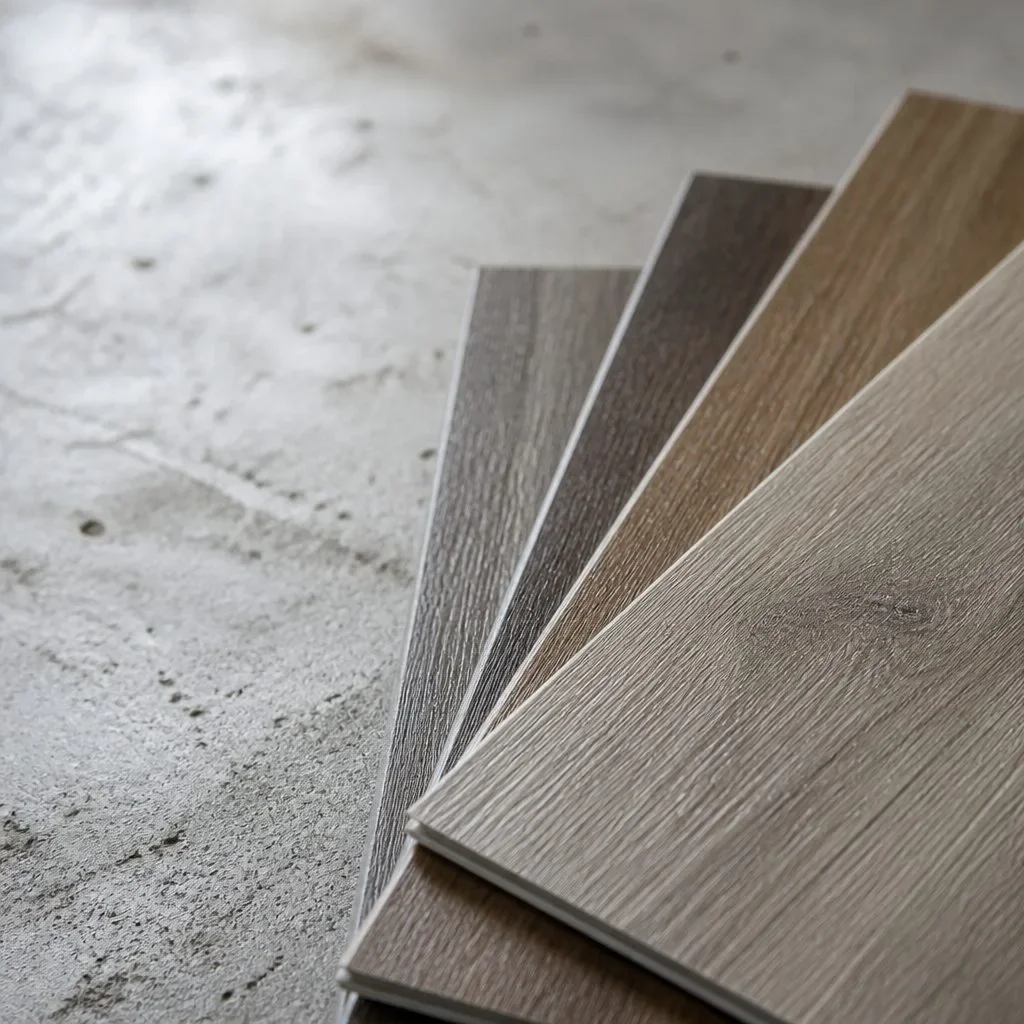
Luxury vinyl plank (LVP) has become the go-to choice for Wichita basements, and it's easy to see why. It's 100% waterproof, handles temperature swings well, and mimics hardwood or tile convincingly enough that most guests won't know the difference. It's also forgiving if the concrete slab isn't perfectly level — something that matters more than people expect in older homes.
Engineered vinyl tile (EVT) and rigid core vinyl are close cousins to LVP, often with a bit more dimensional stability for larger basement footprints.
Ceramic or porcelain tile is another solid option, particularly for basements that double as a laundry or utility space. Tile handles moisture well on its own, though it does conduct cold from the concrete slab, so some homeowners pair it with a radiant heat mat.
Carpet tile can work in finished basement living areas, but only when installed over a proper subfloor system with a vapor barrier — never directly glued to bare concrete in a below-grade space.
What you want to avoid: solid hardwood, laminate without a moisture-rated core, and any carpet pad or flooring installed without addressing the subfloor first.
The Subfloor Question Nobody Talks About
Here's where a lot of basement finishing projects go sideways. Flooring material is only half the equation — what's underneath it matters just as much. A raw concrete slab needs some kind of subfloor system before flooring goes down, whether that's a dimpled plastic subfloor panel that creates an air gap and moisture barrier, or a floating floor system designed specifically for below-grade installation.
Skipping this step to save money is one of the most common mistakes we see in DIY or under-scoped basement finishing projects. The flooring might look fine for the first year, but moisture that has nowhere to go eventually finds its way into the material, and by then you're tearing out flooring you just paid to install.
What This Means for Your Wichita Basement
Local soil composition and our regional humidity swings mean moisture management isn't optional here — it's the foundation (pun intended) of a flooring decision that actually lasts. Before any flooring conversation, it's worth having moisture levels in your slab tested, especially if your home is more than a few decades old or you've never had the basement professionally assessed.
If you're planning a full basement finishing project, flooring is just one piece of a bigger puzzle that includes framing, moisture control, lighting, and ventilation — all of which need to work together. And if your home is in one of the surrounding communities, the same moisture and subfloor considerations apply whether you're in Derby, Andover, Maize, or Goddard — Kansas clay soil doesn't change much from one zip code to the next.
Get It Right the First Time
Basement flooring isn't a project where you want to learn lessons the expensive way. The right material, paired with proper subfloor prep and moisture testing up front, means a basement floor that holds up for decades instead of one you're redoing in three years.
If you're planning a basement finishing project in the Wichita area and want flooring recommendations based on what's actually happening in your space, reach out to Wheatland Construction. We'll walk your basement, talk through your options, and help you avoid the mistakes that cost homeowners the most.